Fast Turnaround in Calgary
Reverse-engineering-ready deliverables
Local Calgary & Alberta
Onsite 3D Scanning
Business & individuals
Quality-first

Fast Turnaround in Calgary
Reverse-engineering-ready deliverables
Local Calgary & Alberta
Onsite 3D Scanning
Business & individuals
Quality-first
Share a few photos and basic dimensions.
Tell us how you plan to use the scan (3D printing, CAD, inspection, etc.).
Need on-site service? Let us know.
We’ll provide an estimate along with our availability, expected duration, and post-processing timeline.
Pricing is based on an initial assessment. Final pricing is confirmed after post-processing and may increase by up to 30% depending on complexity.
We do scanning at your site
OR
Bring your parts to us (drop-off/courier/mail)
Post-processing begins after scan capture
You will receive the link with access to your files in .STL/.OBJ/.PLY format after full payment.
Then you pick-up your parts or we ship them
Raw scan data is optional and by request only
Looking for 3D printing? Explore our 3D Printing Services.

Uses multiple blue laser lines to capture geometry. Blue wavelength helps reduce interference from ambient light and can perform better on shiny or darker surfaces than many white-light methods, with high accuracy for industrial metrology.
High-accuracy metrology and inspection (tight tolerances)
Dark/shiny surfaces (often better results than white light; still may need scanning spray)
Automotive/aerospace parts, machined components, tooling verification

Projects a blue fringe/pattern onto the object and cameras measure how the pattern deforms to reconstruct the surface. Very fast and detailed, great for medium-to-large parts, but reflective/transparent surfaces often may need scanning spray/targets.
Fast full-field scanning for medium-to-large (from 100mm) objects with high detail
Rapid capture of complex surfaces
Best for speed + detail on matte/treated surfaces (spray helps on reflective/transparent surfaces)
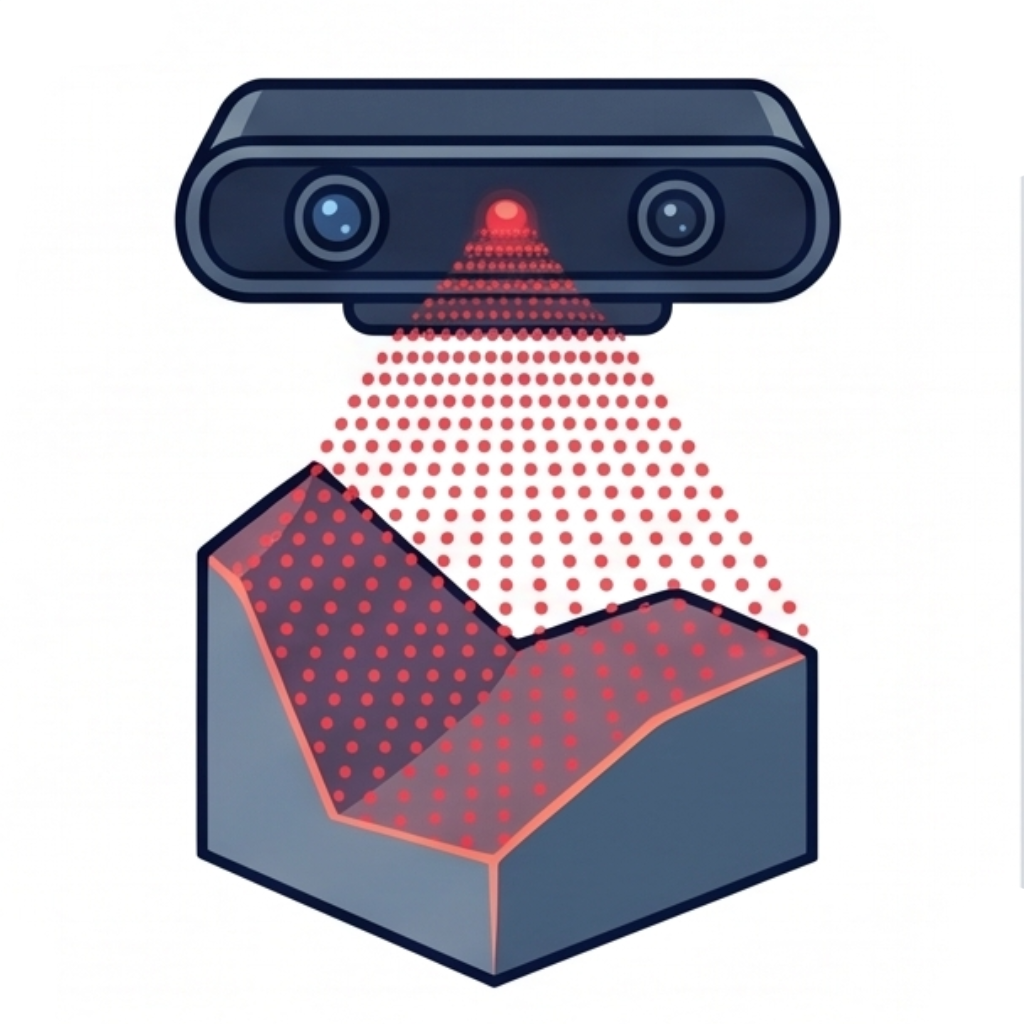
Uses infrared patterns or time-of-flight to estimate depth (common in tablets/phones and some depth cameras). Typically faster and cheaper, good for rough capture and large shapes, but lower accuracy/resolution than metrology scanners and may struggle with sunlight and certain materials.
Quick rough capture for visualization, fit-checks, and general shape reference
Medium and Large objects( from 100mm ), human body scanning, AR/VR, low-cost workflows
Best when speed/portability matters more than precision
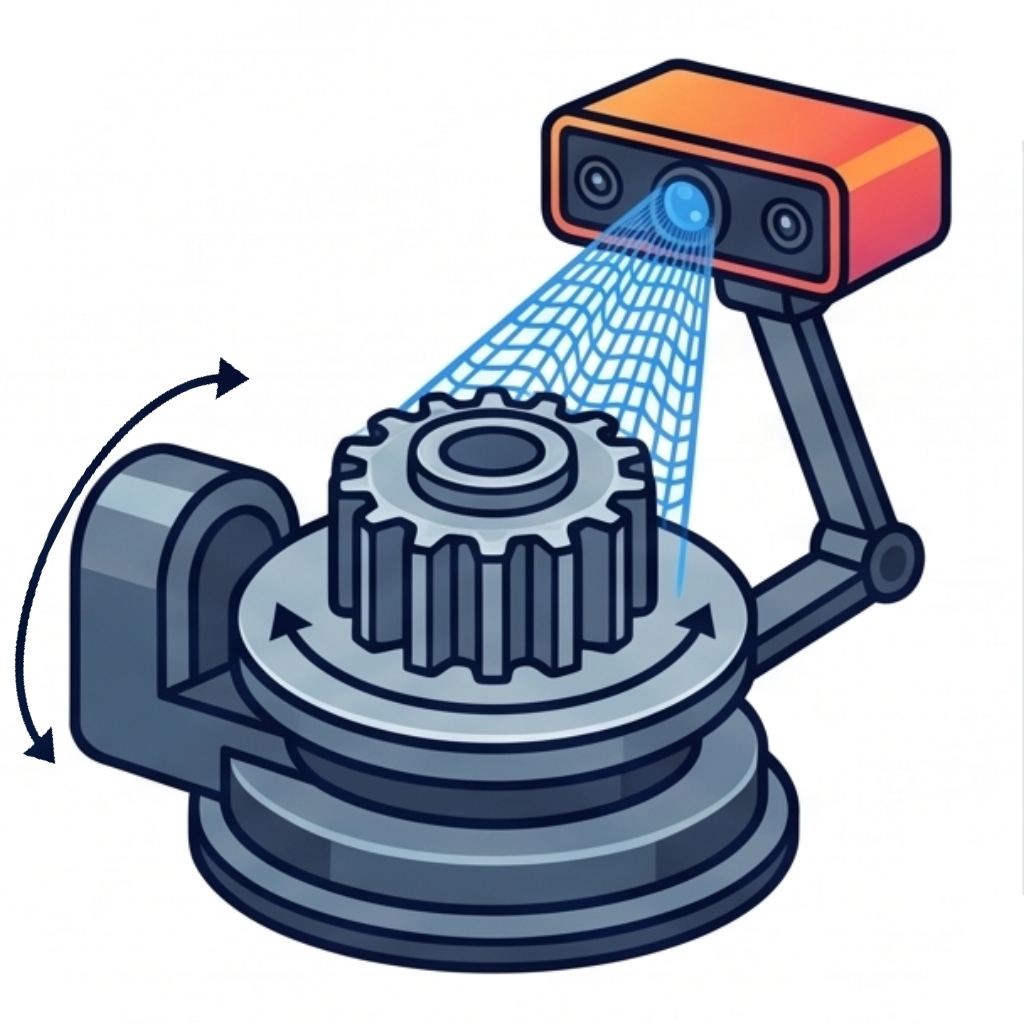
Refers to a structured-light scanner paired with a 2-axis motorized turntable/positioner (typically rotation + tilt) to capture the object from many angles automatically.
Small parts (5mm – 100mm) where you need full 360° coverage (and more undercuts) without hand-repositioning
Repeatable, high-consistency scans for QC/inspection and scan-to-CAD workflows
Batch scanning many similar items using the same automated rotation + tilt program
Parts with hidden faces/undercuts that a single-axis turntable often misses (tilt exposes more surfaces)
Real jobs from our 3D scanning services in Calgary: car parts, engine bays, machine parts and whole doors. Most scans go on to become a CAD model, see our reverse engineering and Scan to CAD services.

The surviving side of a discontinued grille, scanned and mirrored to remake the missing one.

The whole bay on the computer, so brackets and covers can be designed to fit before anything is made.

A full door scanned as an exact base for custom door panels and trim.

An interior part scanned to model from.

A small gear from a limited slip differential, scanned so it can be measured and modelled exactly.

Scanned so the owner could design his own cold air intake in that space.
Small parts you can drop off or ship to us. For vehicles, heavy machinery and anything that cannot move, we bring the scanner to you across the Calgary area and surrounding regions, and further for specialized projects when travel is covered.
We deliver the processed scan in
STL / OBJ / PLY
Raw scan data is available upon request.
3D Scanning
Cleanup
Alignment
Marker removal & Hole filling
Scans Merge/Stitching
Smoothing
Watertight model is optional
Looking for 3D modelling or Reverse engineering? Explore our Reverse engineering & 3D modelling services
We provide 3D scanning for everything from small mechanical components up to complete vehicles. However, if you need us to 3D scan a 150-foot wind turbine blade, we might need a much bigger ladder (and a lot of coffee). The primary physical limitation of 3D scanning is line-of-sight. The scanner cannot capture internal geometry if the optics cannot “see” inside (for example, the deep internal diameter of a small pipe).
To ensure the highest accuracy, your part must be clean and degreased (oil-free). If there is any oil film, grease, or heavy dirt on the surface, our specialized vanishing 3D scanning spray will not work. Please also keep in mind that industrial 3D scanners capture exactly what is in front of them—every single scratch, dent, and surface imperfection will be highly visible in the raw scan data. While we can easily correct these flaws during the reverse engineering phase, starting with a thoroughly cleaned part yields the most precise baseline geometry.
We offer both! For smaller components, you can drop them off or ship them to our Calgary facility. For large objects—such as vehicles, heavy industrial machinery, or immovable pipeline infrastructure—we provide mobile on-site 3D scanning services across the Calgary area and surrounding regions. We are also available to travel anywhere for specialized projects, provided that all travel and accommodation expenses are covered.
Yes. Our equipment operates in a laser scanning mode that easily captures black, glossy, and shiny metal surfaces. However, for the best results on highly reflective or mirrored objects, we use a specialized vanishing 3D scanning spray that automatically sublimates (disappears) after a couple of hours, leaving zero residue. While we can scan without it, using this spray significantly reduces data noise and improves the overall scan quality. It adds a microscopic layer of thickness, but for relatively large objects like a car headlight or engine cover, this is completely negligible.
We utilize professional industrial-grade laser and hybrid light scanners delivering volumetric accuracy up to 0.04 + 0.06 mm/m. This level of precision is more than sufficient for the vast majority of engineering, automotive, and manufacturing applications, allowing us to capture complex custom geometries, fine textures, and physical height deviations with micron-level precision.
Additionally, our equipment lineup includes two highly specialized scanners to cover all possible project needs:
For high-accuracy tracking and seamless data alignment, we typically apply small, non-destructive adhesive or magnetic tracking dots to the surface of the object. These are completely safe for the material and are easily removed after the session. They are especially critical for projects where we need to precisely align “before” and “after” scans.
Yes, we utilize specialized macro 3D scanning technology specifically built to capture micro-details on tiny objects, such as small mechanical gears, electronic housings, or intricate custom components.
Macro scanners operate with a very small field of view to achieve extreme high-resolution results. If an object is highly detailed but wider than this field of view (such as custom textured knives scale), it requires taking multiple overlapping scans. This increases the complexity of data alignment and the engineering hours required to produce a clean, symmetrical model.
Because most of all 3D scanning relies on line-of-sight, the optics cannot penetrate deep micro-holes. We can capture the opening and the start of a thread, but the deep internal geometry will be manually reverse-engineered and perfectly recreated in the final CAD model.
For mechanical and engineering parts, we do not recommend using raw scan data directly. A raw 3D scan is a “mesh” (a dense cloud of triangles) that captures the exact physical state of the object—including real-world wear, scratches, and slight deformations. It lacks perfect symmetry and exact geometric definitions (like true cylinders or perfectly flat planes). While raw scans are excellent for directly replicating organic shapes, sculptures, or art pieces, they are very difficult to edit or use for CNC machining. For precision manufacturing, we always recommend reverse engineering the scan into a clean, parametric CAD model.
Yes, we can mirror the 3D scan data. However, mirroring a raw 3D scan directly is rarely useful for manufacturing because it mirrors all the real-world flaws, wear, scratches, and asymmetrical imperfections of the original part. To get a perfect, manufacturing-ready mirrored part (like a left-side bracket based on a right-side original), we highly recommend reverse engineering the scan into a clean CAD model first, and then mirroring that pristine digital model.
Standard local 3D scanning sessions, including raw data processing and alignment, are typically completed within 1–3 business days. Mobile on-site scanning for larger projects in Calgary is scheduled based on our current availability.
Every job is priced on its own, by the size of the part, the detail it needs and how much post-processing the scan takes. Send a few photos and basic dimensions and you get an estimate with the timeline before any work starts.
Yes. Interior panels, dashboards, engine bays and mounting areas are often scanned right on the vehicle, so the new part is drawn to fit the real car. We can do it at our location or on site.


